
How to compare loan offers by APR and fees, not just the payment
By Petra Nathan · Updated 2026-08-03

Two loan offers can look nearly identical on the monthly payment and still cost very different amounts by the time they are paid off. The payment is what fits your budget today; the total cost is what the loan actually costs you. Comparing offers properly means looking at both.
Start with APR, not the payment
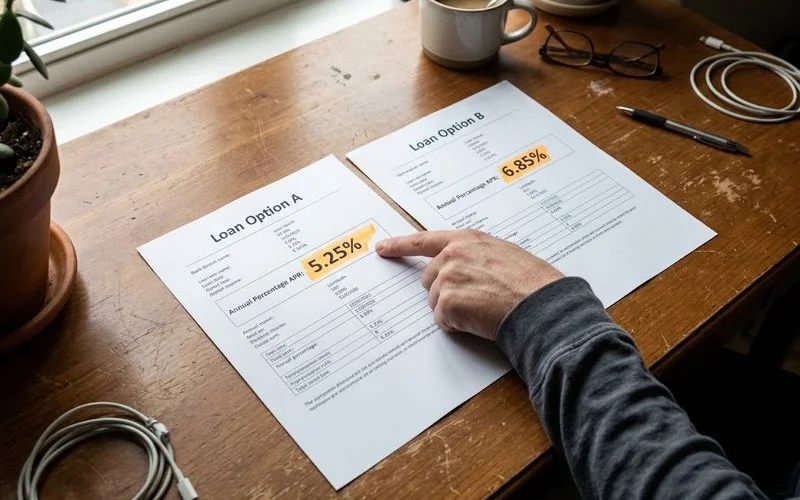
APR combines the interest rate with most required fees into a single annual figure, which makes it the closest thing to an apples-to-apples comparison across lenders. A loan advertised with a low interest rate but a high origination fee can end up with a higher APR than a loan with a slightly higher rate and no fee. Always ask for the APR specifically, not just the rate.
How credit profile typically affects pricing
Lenders price risk into the rate. Based on the pricing tiers our own loan payment estimator tool uses as a general reference, stronger credit profiles tend to land in a noticeably lower tier than thinner or damaged credit files:
| Credit profile | Typical pricing tier |
|---|---|
| Excellent (720+) | Lowest tier |
| Good (680-719) | Standard tier |
| Fair (620-679) | Elevated tier |
| Poor (below 620) | Highest tier |
This is a general pattern across lenders, not a specific quote. Your actual APR depends on the individual lender’s underwriting.
The three numbers that matter most
- APR: the fullest single measure of annual cost
- Total repayment amount: what you actually pay back across the full term, in dollars
- Term length: how long you are committed to the loan, which affects both the payment and the total interest
A longer term lowers the monthly payment but almost always raises the total interest paid, since you are borrowing the same amount for more time.
A simple side-by-side example
| Loan option | APR | Term | Monthly payment | Total repaid |
|---|---|---|---|---|
| Offer A | 13% | 36 months | Higher | Lower total |
| Offer B | 13% | 60 months | Lower | Higher total |
Same rate, same lender, different term: Offer B looks more affordable month to month but costs more overall. Neither is automatically wrong, it depends on what your budget can absorb and how much total cost you are willing to accept for lower payments.
Fees to ask about beyond APR
- Origination fees, often a percentage of the loan taken out upfront
- Prepayment penalties, which can cost you if you pay the loan off early
- Late fees and how they are calculated
- Any required add-on products, such as optional insurance
Putting it together
Before accepting an offer, ask each lender for the APR, the total repayment amount, and whether prepayment carries a penalty. Those three answers tell you more than the payment alone ever will. Asking every lender you’re considering these same questions makes it much easier to see which offer is genuinely better. This same math is what makes a title loan’s real cost worth checking closely before you sign, since fees and repossession risk can outweigh the convenience. This guide is general information, not financial advice; always confirm final terms directly with the lender before signing. See our ranking methodology for how listings on this directory are evaluated.
Questions people ask
- Is a lower monthly payment always the better deal?
- Not necessarily. A lower payment stretched over a longer term can cost significantly more in total interest than a higher payment over a shorter term. Compare the total repayment amount, not just the monthly figure.
- What is the difference between interest rate and APR?
- The interest rate is the cost of borrowing the principal. APR adds in most other required fees, giving you a fuller picture of the loan's true annual cost. When comparing offers, APR is usually the more useful number.
- Should I always choose the loan with the lowest APR?
- APR is a strong starting point, but also check the term length, any prepayment penalty, and the total dollar amount repaid. The lowest APR on a much longer term can still cost more overall than a slightly higher APR on a shorter one.
- Do all lenders have to disclose APR?
- In the United States, federal truth-in-lending rules generally require lenders to disclose APR before you sign. If a lender will not provide this number clearly, treat that as a reason to look elsewhere.